Predefined Equipment Starter Catalog
This catalog lists the industrial equipment definitions supplied with the management
system and their operational points. These entries are ready-made starting content—not
a fixed catalog or a limit on the number and type of equipment that can be managed.
Customers can clone and modify any entry or create new equipment definitions from the
ground up. The catalog is designed for engineering review, proposal attachments, and
print; the reader does not need access to the product console to understand the content.
Predefined starter content
| Coverage |
Delivered content |
| Reusable equipment definitions |
13 |
| Monitoring and control points |
36 |
| Point-level safety profiles |
36 |
| Baseline equipment protections |
66 |
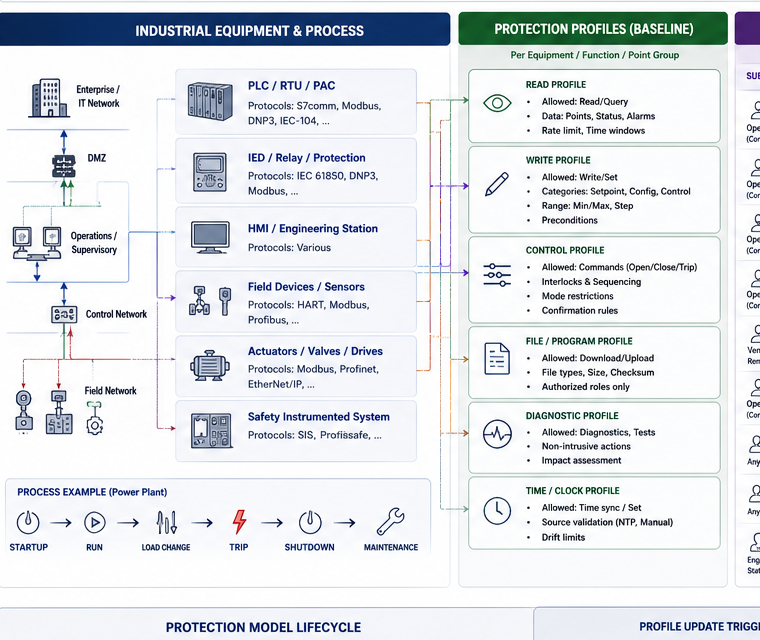
Figure — Protection profiles associated with predefined equipment and point groups.
These figures describe only the content supplied by default. The management system can
hold additional customer-created equipment, points, profiles, and protections according
to the customer's assets and engineering standards.
The catalog spans substation buses, switching equipment, transformer and voltage
control, feeder protection, fault indication, load shedding, and distributed-energy
interconnection. All entries below are operational library content.
Primary plant and voltage control
11 kV Bus 1 — critical busbar
| Point |
Industrial meaning |
Baseline profile |
| AI:8 |
Energized bus voltage supplying Feeder 12 and other north-side feeders |
9.9–12.1 kV permitted measurement range; 11 kV nominal; low alarm at 10.45 kV and high alarm at 11.55 kV |
This definition supports early recognition of undervoltage, overvoltage, invalid
telemetry, and sustained movement outside the approved operating band.
| Point |
Industrial meaning |
Baseline profile |
| AI:9 |
Active transformer loading |
0–120%; 60% nominal; high alarm at 100% |
| AI:10 |
Winding temperature |
−20–140 °C; 65 °C nominal; high alarm at 95 °C |
| AI:11 |
Actual OLTC tap-position feedback |
Valid positions 1–17; nominal position 9 |
| AO:0 |
Requested OLTC tap-position command |
Commands limited to positions 1–17; Select-Before-Operate required; blocking response for invalid control |
The combined definition allows the product to distinguish a process measurement,
actual mechanical feedback, and a requested setting. This is important when assessing
whether a tap request is valid and whether the expected plant response follows.
VR-22 — feeder voltage regulator
| Point |
Industrial meaning |
Baseline profile |
| AI:30 |
Regulated feeder voltage |
110–130 V permitted band; 120 V nominal; low alarm at 114 V and high alarm at 126 V |
| AO:0 |
Regulator setpoint / tap command channel |
Positions 1–32; Select-Before-Operate required; invalid commands blocked |
| AO:1 |
Second regulator setpoint / tap command channel |
Positions 1–32; Select-Before-Operate required; invalid commands blocked |
Capacitor Bank 1 — voltage-support capacitor bank
| Point |
Industrial meaning |
Baseline profile |
| BI:12 |
Capacitor-bank Open/Closed status |
Only recognized binary states; monitored for inconsistent indication |
| CROB:12 |
Capacitor-bank switching command |
Open and Close only; Select-Before-Operate required; unsupported controls blocked |
Feeder switching and automation
F12 Feeder Breaker — high-criticality switching device
| Point |
Industrial meaning |
Baseline profile |
| BI:0 |
Main feeder-breaker Open/Closed feedback |
Valid-state monitoring |
| BI:1 |
Local/Remote control-mode indication |
Valid-state monitoring and remote-control context |
| CROB:0 |
Breaker Open/Close command |
Approved latch commands only; Select-Before-Operate; Remote mode and absence of lockout required; invalid control blocked |
REC-217 — high-criticality field recloser
| Point |
Industrial meaning |
Baseline profile |
| BI:0 |
Recloser primary position status |
Open/Closed state monitoring |
| BI:1 |
Protection-bearing binary status |
Alarm state can enforce a blocking response |
| BI:2 |
Recloser operating-status indication |
Valid-state monitoring |
| BI:3 |
Recloser operating-status indication |
Valid-state monitoring |
| BI:4 |
Recloser operating-status indication |
Valid-state monitoring |
| CROB:0 |
Main recloser Open/Close command |
Approved latch commands; Select-Before-Operate; Remote mode and no lockout required |
| CROB:4 |
Auxiliary recloser control |
Approved latch or pulse action; Select-Before-Operate; unsupported controls blocked |
The generic status labels can be assigned the customer's exact relay-map meanings
during site engineering while retaining their delivered safety behavior.
SEC-41 — high-criticality field sectionalizer
| Point |
Industrial meaning |
Baseline profile |
| BI:10 |
Sectionalizer position |
Valid Open/Closed indication |
| CROB:10 |
Sectionalizing command |
Open and Close only; Select-Before-Operate required; invalid control blocked |
TIE-12-14 — high-criticality normally-open tie
| Point |
Industrial meaning |
Baseline profile |
| BI:11 |
Tie-switch position |
Valid-state monitoring with normally-open operating intent |
| CROB:11 |
Tie Open/Close command |
Approved latch commands; Select-Before-Operate; valid topology and no parallel-outage conflict required |
Protection and load management
F12 Protection Relay — high-criticality feeder relay
| Point |
Industrial meaning |
Baseline profile |
| BI:20 |
Protection trip operated |
Alarm-state monitoring |
| BI:21 |
Lockout 86 operated |
Alarm and blocking context for associated control |
| BI:22 |
Protection element pickup / start |
Alarm-state monitoring |
| BI:23 |
Protection target operated |
Alarm-state monitoring and investigation evidence |
| CROB:20 |
Protection reset / acknowledge control |
Approved Pulse-On or Latch-Off only; Select-Before-Operate; unsupported controls blocked |
FI-217 — downstream fault indicator
| Point |
Industrial meaning |
Baseline profile |
| BI:20 |
Downstream fault indication |
Read-only evidence point; normal and operated states monitored |
Industrial Feeder Load Shed — high-criticality load-shed relay
| Point |
Industrial meaning |
Baseline profile |
| BI:50 |
Load-shed status |
Valid-state monitoring |
| CROB:50 |
Shed / restore command |
Approved latch commands; Select-Before-Operate; unsupported controls blocked |
Distributed energy resources
DER-5 Plant Meter — high-criticality distributed generator
| Point |
Industrial meaning |
Baseline profile |
| AI:0 |
Active generation / export power |
0–5,000 kW permitted range; high alarm at 4,500 kW |
| AI:1 |
Accumulated generation / export energy |
Non-negative kWh measurement monitoring |
DER-5 Intertie Breaker — high-criticality interconnection breaker
| Point |
Industrial meaning |
Baseline profile |
| BI:0 |
Intertie-breaker position |
Valid Open/Closed state monitoring |
| CROB:0 |
Intertie Open/Close command |
Approved latch commands; Select-Before-Operate; acceptable bus voltage and synchronization or dead-bus condition required |
Closing an intertie can alter electrical topology and connect generation to an energized
system. The definition therefore preserves the industrial prerequisites alongside the
command instead of treating it as an isolated packet field.
How to read the catalog
- AI identifies an analog measurement received from the field.
- BI identifies a binary status or indication received from the field.
- AO identifies an analog command or requested setpoint.
- CROB identifies a switching or relay control command.
These point references are included because they are familiar to DNP3 engineers. The
operational meaning remains prominent so operations, protection, asset, and security
teams can review the same catalog.
Site adoption
Delivered values are a reviewed baseline, not a replacement for the customer's
nameplates, protection studies, approved switching orders, relay coordination, or
operating procedures. During adoption, each point is mapped to the site's field device,
limits and command prerequisites are confirmed, and the resulting equipment instance
is placed under engineering change control.
Next: Point and Safety Profiles.