Product Assurance and Qualification
Industrial protection must be evaluated by capability, protocol, traffic path, and use case. L2Proxy distinguishes delivered production capabilities from supported, qualification-dependent, preview, and planned functions.
Purpose and expected outcome
This section supports responsible product evaluation. After reading it, the customer should be able to distinguish delivered capability from qualification-dependent scope, identify required acceptance evidence, understand product boundaries, and prepare a controlled production decision.
Assurance principles
- Parser visibility is not presented as equivalent to a validated protection policy.
- Stateless and stateful maturity are stated separately.
- Customer traffic and equipment mappings remain part of production qualification.
- Monitoring can precede blocking without rebuilding the policy model.
- Representative normal, abnormal, timeout, replay, and recovery cases are retained as validation evidence.
- Product boundaries are documented alongside benefits.
Qualification chain
Confirm protocol and traffic visibility
        ↓
Confirm equipment and point mapping
        ↓
Review policy and safety assumptions
        ↓
Validate recorded and representative operations
        ↓
Commission in the approved operating posture
        ↓
Activate enforcement under change control
        ↓
Review evidence and maintain regression cases
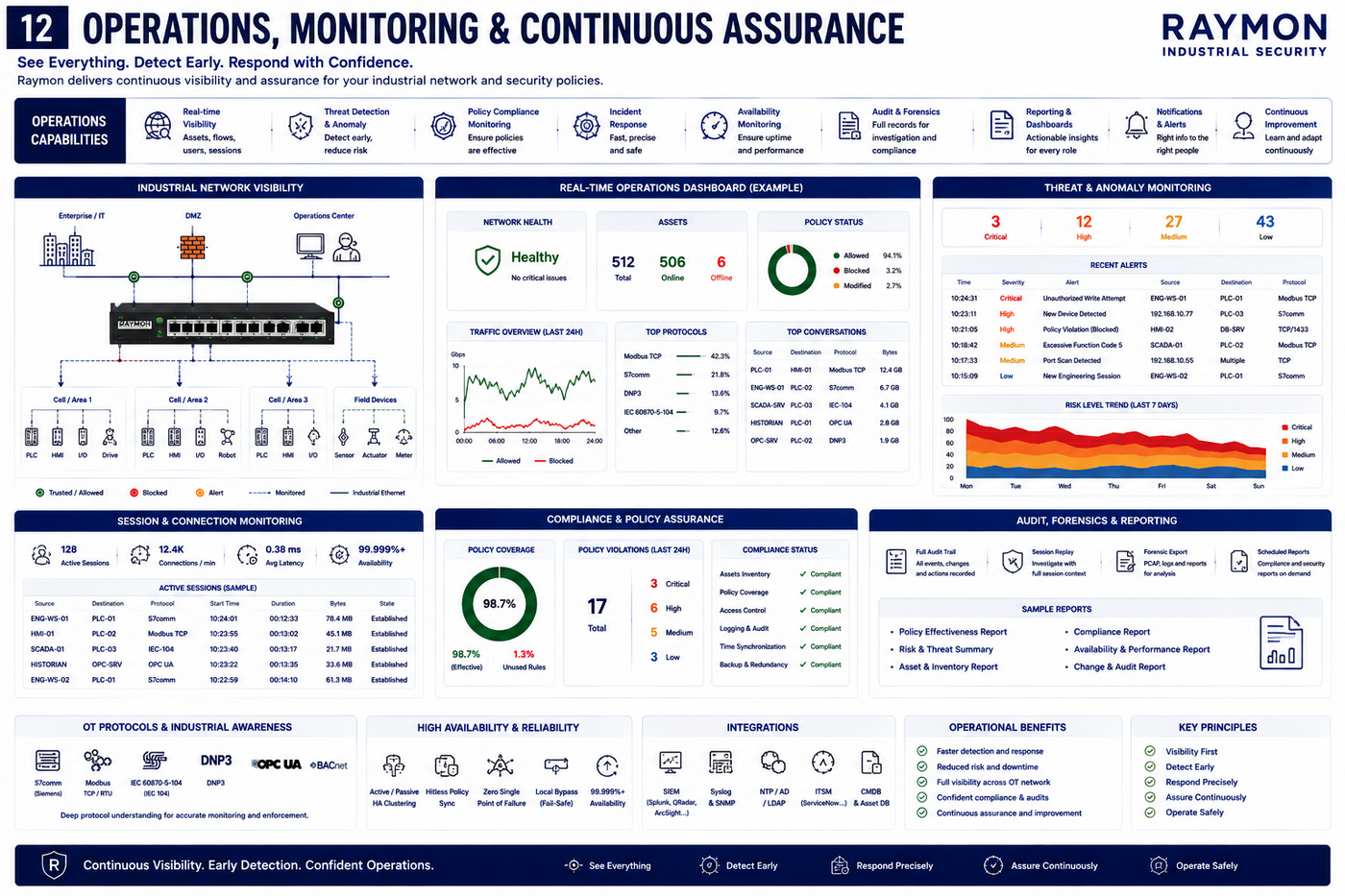
Figure — Assurance and qualification rely on continuous visibility, evidence, and operational review.
Evidence expected for a production policy
| Evidence | Purpose |
|---|---|
| Equipment and point-map approval | Confirms industrial meaning |
| Policy revision and owner | Establishes responsibility and source of truth |
| Representative normal cases | Demonstrates permitted operation |
| Violation cases | Demonstrates intended recording or blocking |
| Stateful edge cases | Covers timeout, replay, duplication, and missing sequence where applicable |
| Policy Profile revision | Identifies the complete deployed policy set |
| Enforcement assignment | Identifies whether policy is enforced by L2Proxy Connect or a standalone service, and where |
| Identity-context test | Confirms authenticated user and session attribution when L2Proxy Connect is selected |
| Rollback procedure | Supports controlled recovery |
L2Proxy Connect acceptance evidence
An identity-aware deployment should include a permitted-user case, a denied-operation case, session attribution in both dissection and rule-decision records, session closure behavior, and the approved forwarding posture if the enforcement component becomes unavailable. These checks supplement the protocol and equipment tests above.
Transparent product claims
The Capability Status page states current maturity by area. Product Boundaries explains what L2Proxy does not replace and which deployment assumptions must be considered.
These qualifications help customers distinguish a demonstrated industrial capability from a protocol or roadmap statement and plan an appropriate acceptance process.